Google showcases five Gemini 4 Neon projects and points developers to paid-tier API access
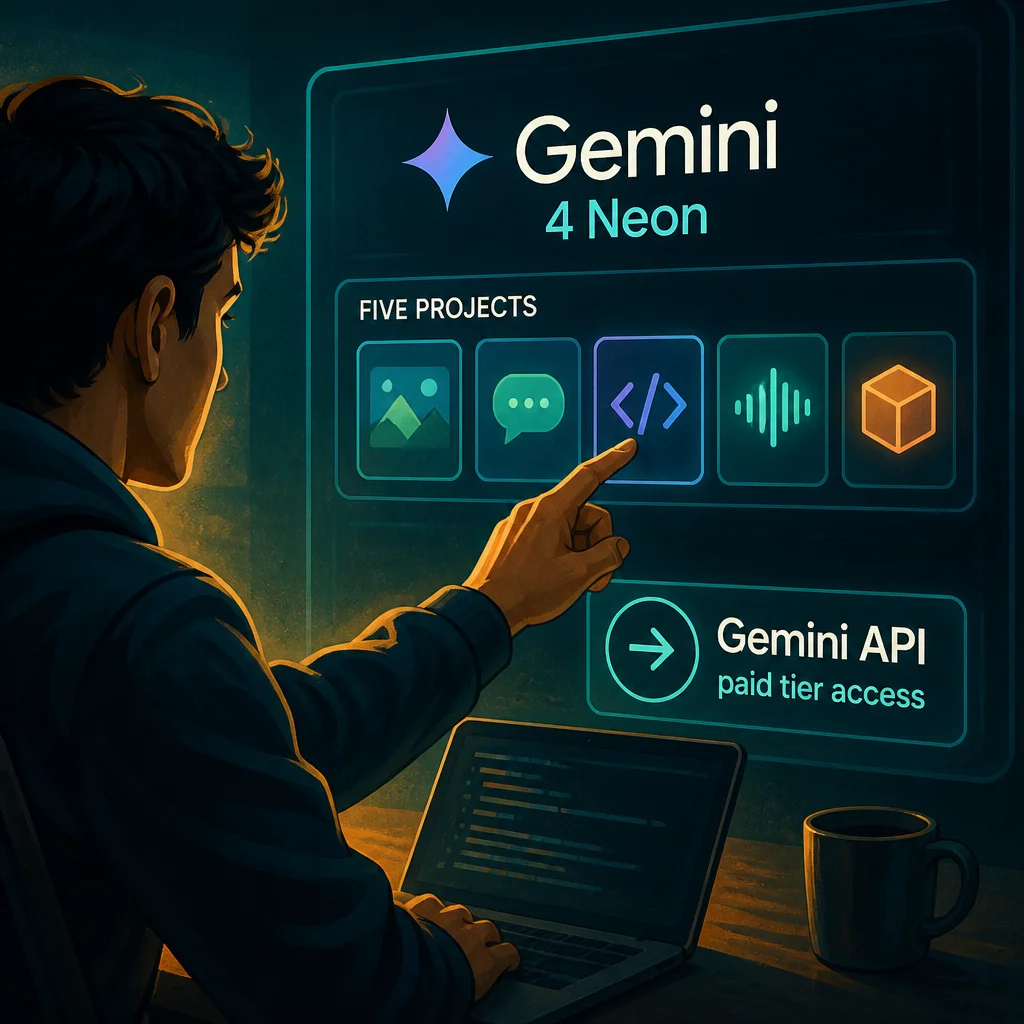
Developers can get started with Gemini 4 Neon through the Gemini API paid tier in Google AI Studio and Android Studio, according to Google.[1] Single-source detail In its showcase, Google says two builders used Neon in Google Antigravity to create a glowing 3D Earth and a set of Three.js butterflies. The Earth project used the high thinking setting, while the butterfly project used xhigh.[1]
Single-source detail Google also highlights an interactive web shader made with the /swarm command and a 3D black hole shader with switchable camera views and lensing controls. The company says the web shader took under five minutes to build.[1] Single-source detail A fifth example is a 3D pendulum-wave simulation in which spheres move at different periods to produce traveling interference patterns, according to Google.[1]
Evidence checks
Passed automated source review
- 2 direct
- 3 attributed
Evidence confidence 75/100
Headline evidence: 85/100. Weakest body claim: 60/100. The score weights those two measures 60% and 40%.
This is an evidence-strength rubric, not a probability that the story is true. Independent corroboration scores 90, direct primary evidence 85, and attributed reporting 60. More links repeating the same source do not add points.
Claims and their sources
- Direct evidenceGoogle Gemini
Developers can get started with Gemini 4 Neon through the Gemini API paid tier in Google AI Studio and Android Studio, according to Google.
Direct evidenceGoogle GeminiIn its showcase, Google says two builders used Neon in Google Antigravity to create a glowing 3D Earth and a set of Three.js butterflies. The Earth project used the high thinking setting, while the butterfly project used xhigh.
Attributed reportingGoogle GeminiGoogle also highlights an interactive web shader made with the /swarm command and a 3D black hole shader with switchable camera views and lensing controls. The company says the web shader took under five minutes to build.
Attributed reportingGoogle GeminiA fifth example is a 3D pendulum-wave simulation in which spheres move at different periods to produce traveling interference patterns, according to Google.
Attributed reportingGoogle Gemini
Full coverage
Original sources
- Google GeminiPrimary evidence · Attributed statement